


Community Education
River Safety
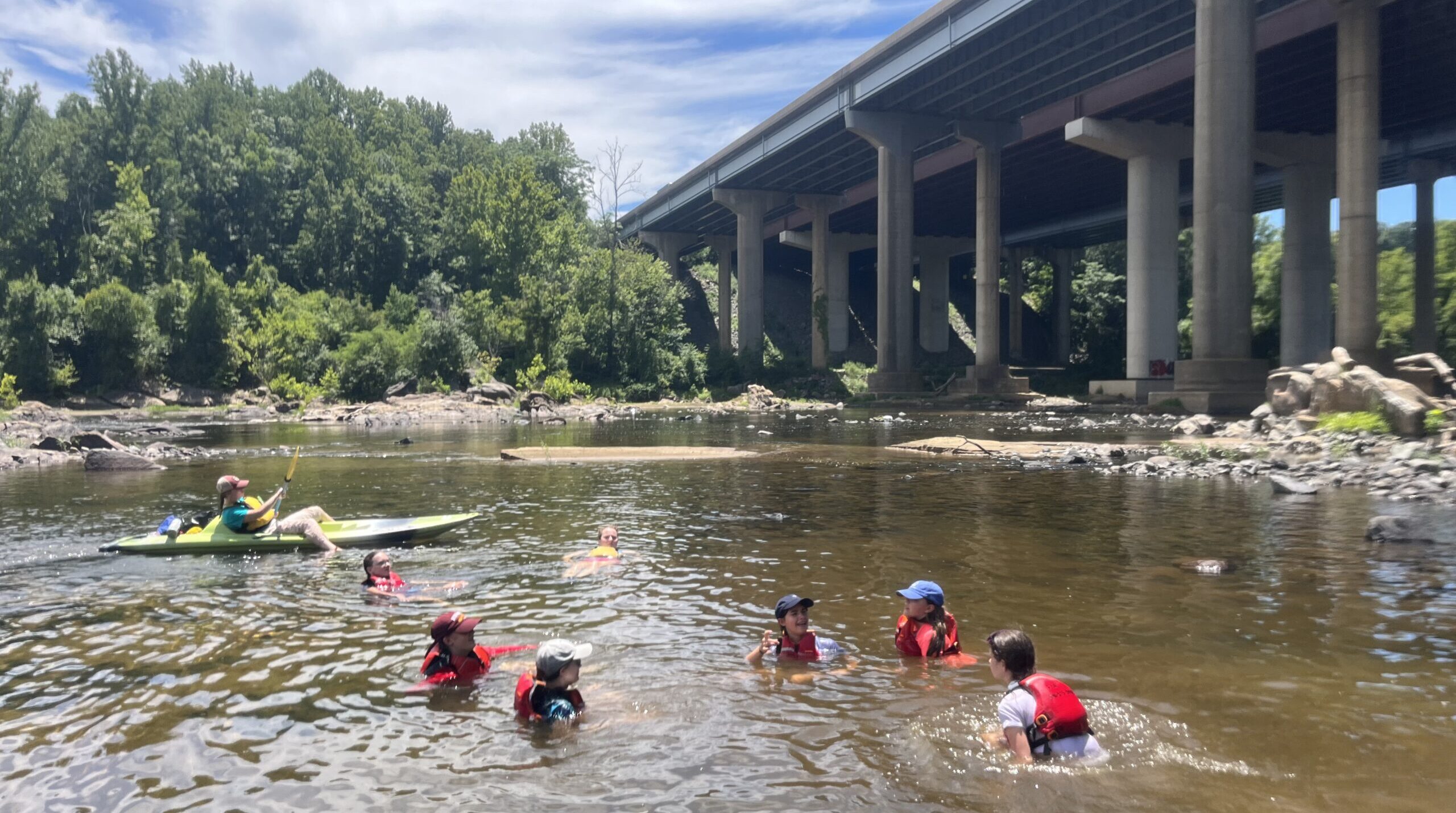
The Rappahannock River has natural free-flowing patterns that can be learned, but cannot be controlled or memorized. The river is different every day. This is why it is important to pay attention to all the factors before and while on the river.
Do you love this resource? Donate to keep it running!
This project was made possible originally by Dev Patel as part of his Eagle Scout Project with Boy Scout Troop 21. It has been maintained and supported by Friends of the Rappahannock Staff and Fredericksburg Technology .
How to Read Water Gauges
River gauges are signs that are set up along the river to help you figure out if the river is safe to recreate on or not.
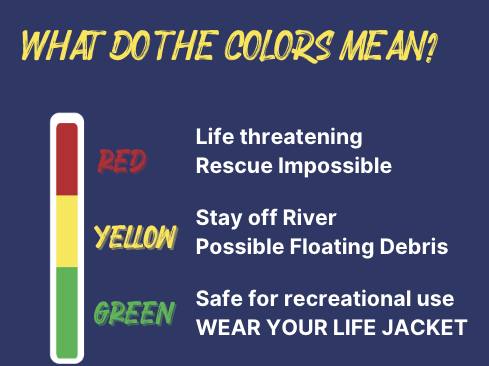
Our River Gauges are set up exactly like a stoplight.
Red means “DO NOT RECREATE UNDER ANY CIRCUMSTANCES.”
Yellow means “Use extreme caution, and it’s not recommended to be on the river.”
Green means you are “You are good to recreate, but always wear your life jacket.”
Where to See Forecasted & Current Water Levels Across the Watershed
Visit NOAA’s National Water Prediction Service to see what levels are currently and what they are predicted to be in the near future.
Need some help understanding how to best use the gauges? Check out this YouTube video explaining more!

River Recreation Checklist
- Buddy System
- Never wade, tube, swim, or boat alone. Visit the river with someone who knows the river.
- Life Jacket
- Also called a Personal Floatation Device (PFD) is essential for fishing, wading, tubing, swimming, or boating in moving water.
- IT’S THE LAW: Any person who requires a rescue when the white water area is at the yellow or red water mark can receive a fine of $100.00. Any person requiring a rescue when the water level is at the yellow or red water mark shall be responsible for all reasonable and necessary expenses incurred by the rescuing agency.
- Water Levels
- Check the river level gauges before beginning your trip. When the river is in the GREEN area, life jackets are essential. In YELLOW & RED, stay off the river, as rescue is difficult or impossible.
- Equipment
- Wear closed-toed shoes, appropriate clothes, and sun protection. Bring a first aid kit and drinking water.
- Personal Ability/Condition
- We encourage you to only use the river if you know how to swim. Non-swimmers often panic, endangering themselves & others. River recreation is demanding; be fit and educate yourself.
- Conditions: Weather/Time of Day:
- Lightning, cold weather, high wind, dusk – ALL mean get off the river until conditions improve.
- NO alcohol or drugs
- Impaired coordination and judgment increase the risk of loss of life.
- IT’S THE LAW: Boating while intoxicated (BWI) is prohibited under Virginia law. Violators will be prosecuted. Possession of Alcohol is prohibited at all public access points, parks, and riverbanks. Violators will be ticketed. Possession of alcohol by anyone under the age of 21 years of age will result in the revocation of their driver’s license.
Recognizing Potential Hazards
- High Water: Swiftly moving, muddy water, or a river flooded out of its banks into trees are all signs to stay off the river.
- Strong Current: Current is stronger in restricted areas and when the water is high. Risk cannot often be seen.
- Uneven Riverbed: Deep holes, uneven current, rocks, roots, broken glass, and fishing line all pose real dangers.
- Hypothermia: Cold water exposure or even dampness with wind chill can cause loss of coordination, clouded thinking, unconsciousness, or death.
- Diving: Diving in shallow water or into unexpected rocks and logs can cause injury, paralysis, or death.
- Hydraulics: Hydraulics send water falling over ledges or dams, creating holes, then recirculating the water to fill the holes, dragging trapped victims down repeatedly.
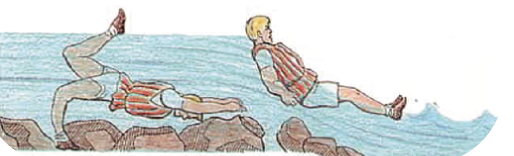
- Strainers: Strainers such as downed trees, debris piles, and undercut rocks let water flow through but strain our boats and bodies, holding them under. Walk around or climb over.
- Entrapment: Foot entrapment between rocks or in debris causes the current to force the victim underwater. To avoid this, FLOAT! Keep your feet up and downstream to avoid getting your feet stuck.
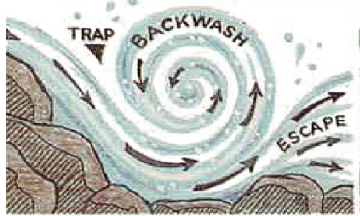
Hydraulics Depiction
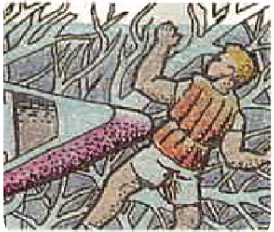
Strainer Depiction